Tale Structure
There are several dimensions to understand when creating a Tale. These are explored in the subsections below.
Note that this is how Jeff and Jordan approach Tale creation. It's been a successful process, but it's not the only path to a small Tale sized and shaped LARP. While we encourage you to use the scheme suggested below, we recognize that brilliance comes in many forms. Tell your Tale as you see fit, and we'll figure out how to make it work in the larger collection. There MUST be a Tale Details for the GM page, regardless of the format.
Since we don't know what kind of Tales will result, each Tale should stand on its own. The players can choose to incorporate the decisions and experiences of earlier Tales into their actions in later Tales. If we get a brilliant set of Tales that would let us build a logical decision tree and set of Tale paths, we can always experiment with it.
Physical Components
A Tale is a small LARP, with the usual components of many LARPs. There are some limits, given the intention to run the game across a video connection. The components include:
Component |
Description |
|
1 |
In an operational model where a GM sets up and runs the game, distributing the game materials by email at runtime or beforehand, they need to know what to do. This page contains the logistical information necessary to get the right pieces into the players' hands. This page also contains notes about the Tale from the author, that may be valuable to whoever is running the game. Any safety concerns and sensitive subjects should be noted in the GM Notes. This page may also contain framing text, for the GM to read before and/or after the Tale. The Tales of Irnh uses a short framing paragraph of text to set up the next Tale. The GM Notes for And the Children Shall Lead contains an example of framing text, to read before the Tale begins. It is not necessary to have a clever, punning title for the Tale, but there is a long tradition of doing so. |
|
2 |
The Tale sheet is a short summary of the setting and the problem. It should make the dilemma clear, and suggest who must make the difficult decision. It may be useful to have two different Tale sheets, to provide two different perspectives or goals, as in And the Children Shall Lead. This is why there are two Tale links on the left. Three Tale sheets is too many — that kind of information belongs in the character sheets. A Tale should define and provoke conflict. They should create drama. It is also possible to write a conflict with humor that creates laughter. The Tale must be specific, focused on that decision. Negotiating a peace treaty is not focused enough. Dealing with a hostage situation can be, provided there is a way to find a resolution. You should be able to describe the dilemma in a single sentence. It is not necessary that all of the characters survive the Tale. Giving someone the chance for a heroic death can create a powerful, dramatic scene. Having to make a life and death decision, with the implications clear and immediate, can produce memorable moments. It helps readability to bold the first use of Proper Names and important terms. Tale sheets should be no longer than one page, if possible, at a reasonably large font size. (12 pt or larger.) |
|
3 |
The Character sheet should be a short description of how the given character sees the problem and how they feel about it. Do they demand action? Do they insist on running away? Do they support one of the other characters? This is a chance to boil down a character to their core beliefs on a specific topic. As with the Tale sheet, it helps readability to bold the first use of Proper Names and important terms. All characters should be written as gender neutral, with they/them pronouns. It's a challenge, to be sure, but one that can be met. (They/them is so ingrained now that Jeff and Jordan have a difficult time trying to write gendered characters these days.) These should be no longer than one page, if possible, at a reasonably large font size. (12 pt or larger.) |
|
4 |
Name Tags (TBD) |
Names, especially alien names, can be difficult to remember in an intense, dramatic moment. Normally, there would be name tags in a badge holder, or a "My Name Is" sticker on someone's chest. This doesn't work well over a video connection. Nevertheless, having something with a name in large text would help. We will experiment with using a full sheet of paper, folded in half, with the name on either side of the fold, as is often done in meetings. It also helps to keep alien names simple. Anyone have a brilliant idea here? |
5 |
Contingency Envelopes |
Contingency envelopes, which contain additional information for certain situations (e.g. "Open when you meet character 39" → "This is your long lost son!") are problematic in the short timeframe of a Tale. Furthermore, there are logistical problems that make them even harder to distribute and use in a fully video-based environment. Please try to avoid the use of Contingency Envelopes. If you must do something like this, write it into the character sheet and trust the player to do the right thing. (e.g. "After a few minutes, you'll realize Glowing Blob is your long, lost uncle.") |
6 |
Props |
Props are a challenge, in that they can't be easily shared or passed around. This may be a useful way to tell a story, provided that the person playing the role with the prop can print or scrounge an acceptable representation. And the Children Shall Lead calls for The Alien Gizmö, which could be anything. The name is deliberately generic, which means the player can bring anything to the game. Consider the classic paper props of contracts and payoffs, in an environment where people are physically remote. Contracts can be written and distributed in PDF, which can be signed and returned. Physical money is out of the question, but do you have a clever way to model electronic funds transfers? One must consider how a Tale is affected if Murphy strikes and causes difficulties in communication. Carefully consider the use of props in your Tale. |
Components of a Seven Page Tale
What a seven page Tale looks like:
- One page GM sheet
- One page Tale sheet
- One page Character sheet × five characters
Story Components
A Tale describes a crisis, big or small, that must be resolved. The decision should not be black or white, but gray, where both sides are valid, horrible, ethically challenged, or have unexpected complications. We can raise questions of ethics or morality through the language and trappings of science fiction. We can explore what it means to be "other." Despite the bumpy ridges on the foreheads of our aliens, we can delve into the most human of conditions.
And the Children Shall Lead has two issues:
The parents have to deal with the wayward children.
The children have to decide what to do with the Alien Gizmö.
Jeff and Jordan like to think of dilemmas and decisions in terms of triangles. The person making the decision is at the apex of the triangle. There's someone advocating for the choice and another advocating against it. In a five player Tale, the two remaining characters represent another pair of for and against voices, or want to argue for and against a third, less tenable option.
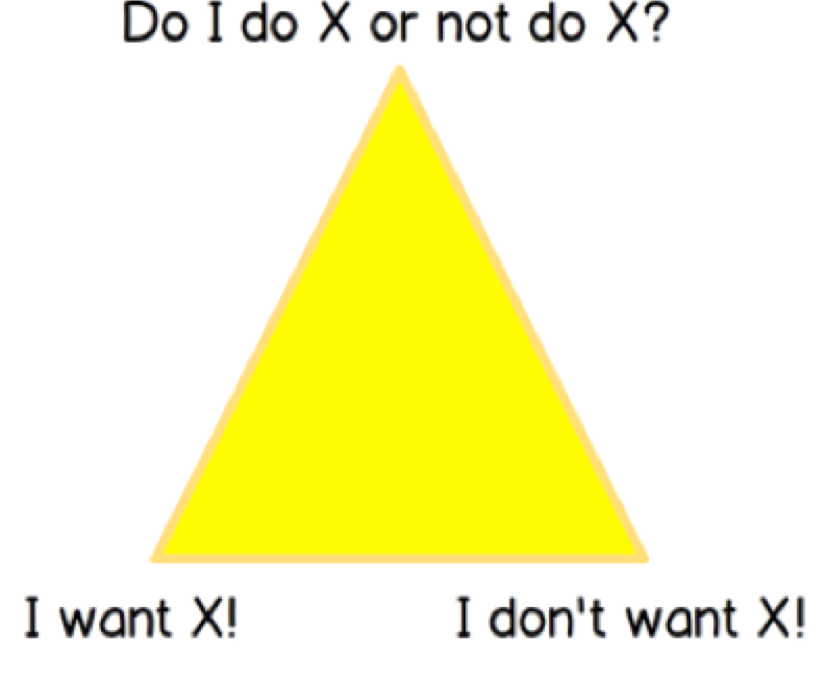
In And the Children Shall Lead, there are two triangles:
-
Ultramarine, Vortex of Chaos, and the three children as a unit. Vortex of Chaos is in charge, and must decide on any punishment. Ultramarine would like something harsh. The kids want Vortex to go easy because of their discoveries.
-
Deep Dark is the nominal leader of the expedition; the other young wouldn't be here without her. The three of them are under the effects of the Alien Gizmö. Equations of Insight does not want the Gizmö revealed, but it is causing trouble for Deep Dark and Lapislazuli. How will they deal with this?
Both triangles fit together nicely.
In a longer, more traditional LARP, we might play out the experiences of the children on Crouse 4454β+02. We might also play out the consternation of the parents when they discovered they had to change the Fleet launch because of the missing children. Instead, we put that into the Tale backgrounds and only play out the dramatic conflict and resolution.
Most Tales will be simpler than And the Children Shall Lead.
Yes, we've broken our gender neutral rule in the example. Vortex of Chaos is a female character in Across the Sea of Stars and appears in several works of our fiction. She is female because we've written her that way for twenty-some years. She's female because all Human ships are historically female. She's also Deep Dark's mother. Deep Dark follows the tradition, appearing in a work of fiction and being a Human ship. They are female in our heads, and always will be.